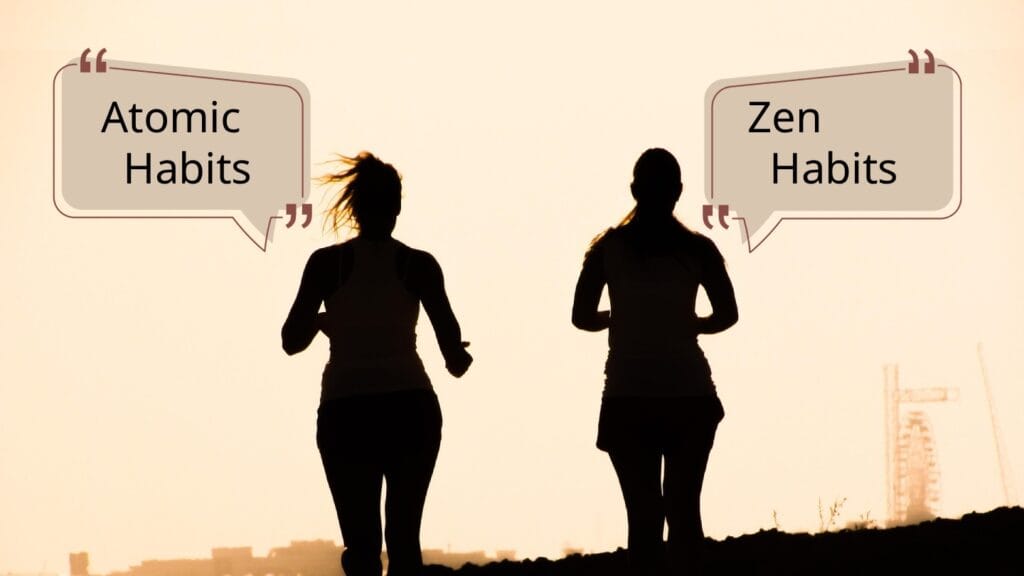
“We are what we repeatedly do. Excellence, then, is not an act, but a habit.”
Aristotle (or Will Durant, depending on who you ask) said it best. We all want to change. We want to be fitter, wealthier, and happier. We want to write that book or run that marathon. But every year, we watch our motivation crash and burn by mid-February.
The problem usually isn’t a lack of willpower. It’s about finding the strategies and habits that click with who you are and make success a breeze.
In the world of personal development, two distinct philosophies have risen to the top. In one corner, we have the precise, scientific approach of James Clear’s Atomic Habits. In the other corner, we have the mindful, minimalist approach of Leo Babauta’s Zen Habits.
One is about engineering a better life through systems. The other is about stripping away the noise to find peace in the process.
It is not about which book is “better”. It is about which method matches your current psychological state. Are you looking to optimize a machine that is running well? Or are you trying to restart a machine that has completely stalled out?
The goal is to help you find the strategies that fit your natural strengths, and by the time you finish reading, you’ll clearly see where you fit.
Stop chasing random habits! Learn whether Atomic Habits’ science or Zen Habits‘ simplicity is the true path to a better you.
Atomic Habits: The Science of Tiny Gains
James Clear approaches habits like a scientist or an engineer. If you are not getting the results you want, he argues, it is not because you are a bad person. It is because your system is broken.
The core of the Atomic Habits philosophy is the “Aggregation of Marginal Gains”. This idea is that if you get just 1 percent better every day for a year, you will end up better by the time you are done. That means Small steps lead to massive results. If you improve just 1% every day, those little changes pile up to make a huge difference after a year.
Systems Over Goals
Most of us are taught to set big, hairy, audacious goals. We want to lose thirty pounds. We want to make six figures. James Clear argues that winners and losers have the same goals. Every Olympian wants the gold medal. The difference is not the goal. It is about the daily routine they use to get there.
Clear suggests shifting your focus from what you want to achieve to who you want to become. This is Identity-Based Habit formation.
Instead of saying, “I want to run a marathon,” you tell yourself, “I am a runner.” Instead of saying “I want to write a book,” you say “I am a writer.”
When you change your identity, the habits follow naturally. A runner goes for a run. A writer writes. You are no longer fighting against yourself; you are simply acting in alignment with who you are.
The Four Laws of Behavior Change
Clear gives us a tactical manual to build these systems. He calls them the Four Laws of Behavior Change. If you want to build a good habit, you need to pull these four levers:
- Make it Obvious: Stop relying on memory. Design your environment so the cue is staring you in the face. Put your running shoes in front of the door.
- Make it Attractive: Pair the tricky thing with something you love. Only listen to your favorite music while you are at the gym.
- Make it Easy: This is about reducing friction. If you want to draw more, keep a sketchbook on your desk, not hidden in a drawer.
- Make it Satisfying: Give yourself an immediate reward. Our brains are wired for instant gratification, so you need to feel a win right now, not just six months down the road.
Who is this for? This method is for the Optimizer. If you love data, tracking apps, spreadsheets, and structure, this is the precise blueprint for your transformation. It works best if you already have a somewhat stable life and you are looking to maximize your potential.
Zen Habits: The Art of Subtraction
If James Clear is the scientist in the lab, Leo Babauta is the monk in the garden. Zen Habits was born out of Babauta’s own struggle with debt, weight, and stress. His approach is not about adding more tasks to your schedule. He wants you to remove the clutter so you can actually finish what you start.
This method relies on mindfulness, simplicity, and a radical reduction of noise. It is about changing your life without hating yourself in the process.
The Power of One
Think about your last New Year’s Resolution list. You probably promised to quit sugar, eat out less, go to the gym five times a week, wake up early, and save more money. You tried to do it all at once. And you probably failed.
Babauta’s golden rule is the “Power of One”. You pick one habit. Just one. You focus all your energy on that single change for four to six weeks until it is automatic. Only then do you move to the next one.
In the beginning, it feels too slow. Your brain wants to do more. But since you are not doing too many things at once, you will reach your goal.
Make it Ridiculously Small
While Clear talks about making it easy, Babauta takes it a step further. He suggests making the habit so small that you cannot say no.
Do not commit to meditating for twenty minutes. Commit to taking three deep breaths. Do not commit to running a mile. Commit to putting on your shoes and stepping out the door.
The biggest hurdle is the starting friction. By lowering the bar to the floor, you remove the mental resistance. You build trust with yourself. You prove to yourself that you can show up, even if it is just for thirty seconds.
Compassion as a Tool
This is where Zen Habits really diverges from the pack. In the optimization world, missing a day often feels like a failure. We beat ourselves up. We feel guilty.
Babauta teaches that guilt is the enemy of consistency. If you stumble, you treat yourself with kindness. You get curious about why it happened, rather than angry. You simply restart. Self-compassion is the fuel that keeps you going when your willpower runs out.
Who is this for? This method is for people who feel Overwhelmed. If you are tired, anxious, or trying too hard to be perfect, a complicated plan will just stress you out. You need a habit method that feels like a relief, not a burden.
The Showdown: Structure vs. Spirit
So, we have the Engineer vs. the Monk. Let’s look at how they stack up.
| Feature | Atomic Habits (Clear) | Zen Habits (Babauta) |
|---|---|---|
| Approach | Additive & Systematic | Subtractive & Mindful |
| Focus | Optimization & Efficiency | Simplicity & Focus |
| Failure | A system error to be fixed | A moment for self-compassion |
| Best For | Scaling up performance | Starting from zero / Burnout |
The Friction Debate
Both authors agree that friction is key, but they tackle it differently.
- Clear says: Design your environment to remove friction. If you want to exercise in the morning, lay out your workout clothes and shoes right next to your bed the night before. You are organizing your room so that getting dressed is easier than making excuses.
- Babauta says: Lower your expectations to remove mental friction. The friction isn’t just in the environment; it is in your head. Make the task easier to stop the struggle in your mind. The problem often isn’t your surroundings; it is the fear of the effort. By making the habit ‘ridiculously small,’ you make the task feel effortless instead of overwhelming.“
Sustainability Check
- Atomic Habits works incredibly well when your life is relatively stable. When you have control over your environment and your schedule, you can build a masterpiece of efficiency.
- Zen Habits shines when life is chaotic. When you are moving houses, changing jobs, or raising a newborn, you cannot always control your environment. But you can control your decision to perform one small, mindful habit. You can always find time to begin, no matter how small the task.
The Hybrid Method: Creating Your “Eureka” Moment
Here is the secret:
You don’t have to pick a favorite. Simply use the best parts of both methods.
If you are stuck in a rut, start with Zen Habits. Strip everything away. Pick one thing. Make it so small you can’t fail. Be kind to yourself. Use this phase to build your confidence and prove to yourself that you can change.
Once that habit is locked in and you are feeling strong, switch to Atomic Habits to scale up. Now that you are showing up every day, how can you optimize it? How can you stack another habit on top of it? How can you design your room to make it effortless?
Bonus: Quiz – What is Your Habit Style?
Still not sure which book to pick up first? Let’s check your Habit DNA.
1. How do you feel about spreadsheets and tracking apps?
- A: I love them. Seeing a streak makes me happy.
- B: They stress me out. I feel guilty if I miss a box.
2. What is your current stress level?
- A: Manageable. I want to get more done.
- B: High. I feel like I am drowning in tasks.
3. How do you handle missing a day?
- A: I analyze why and try to fix the schedule.
- B: I beat myself up and often quit entirely.
4. How many things do you want to change?
- A: Everything. Diet, gym, reading, and finance. Let’s go.
- B: Everything, but just thinking about it makes me tired.
The Verdict: If you answered mostly A, you are ready for Atomic Habits. You have the mental bandwidth to build a system. If you answered mostly B, you need Zen Habits. You need to slow down to speed up.
Conclusion
Don’t worry about picking the ‘perfect’ system. The best method is simply the one you actually stick with.
Whether you choose the scientist’s lab or the monk’s garden, the goal is the same. You are trying to build a version of yourself that you are proud of.
So pick your side. Are you going to engineer your life, or are you going to simplify it?
Tell us in the comments below which method you are trying first!